Finding the best training shoes
by Rhys Martin on Wednesday 15 April 2026
3 min read
A quick guide to finding the best training shoes
Whether it’s a half marathon, park run, or simply impressing the local run club, choosing the right training shoes is an important step.
Unfortunately, if you typed the “best gym shoes” into Google or ChatGPT, you know the options are overwhelming. The athletic footwear market is massive – it was valued at $145.49 billion in 2025. That’s a lot of shoes!
In true Virgin Active style, we’re here to cut through the BS and get real, quickly.
Quick tip: Joining a run club near you is a great way to keep you motivated, especially if you’re a beginner. Read more about the benefits of a run club.
3 things to look for in a training shoe
1. Flexibility for overall comfort
How flexible or stiff the shoe is can make a huge difference to your comfort, especially when you run. As a general rule of thumb – or in this case, toe – running shoes should flex at the same locations as your foot. For example, if you hold your shoe at the sole and bend the front of the shoe upwards, it should only flex at the ball of the foot.
However, if you’re someone who gets stiffness or pain when you flex your toes upwards, some shoe stiffness may be better. That’s because it can reduce some of the motion and protect your joints.
Another key consideration is the type of surface you’ll be working out on. If you’ll mostly be running on the treadmill, a pair with flexibility would be the best gym shoes. For park runs, where there are potential bumps and hazards, having too much flexibility could increase your risk of injury.
2. Cushioning for shock absorption
Every pair of training shoes has some cushioning. Finding the right amount of cushioning for your purpose is important. For example, if you’re training for a half marathon, then extra cushioning will help with impact absorption on those longer distance runs.
On the other hand, lighter shoes with less cushioning can help you feel faster, and midsole foams are a bit of a middle point.
3. Heel counter for ankle motion
Heel counter simply refers to the rigid or semi-rigid section at the back of the shoe surrounding the heel.
If you’re after a training shoe for running, then choose one with a heel that has some rigidity while still allowing comfortable ankle motion. If you’re mostly lifting weights, then the best gym shoe is one with a rigid heel for stability.
Comparing the best training shoes
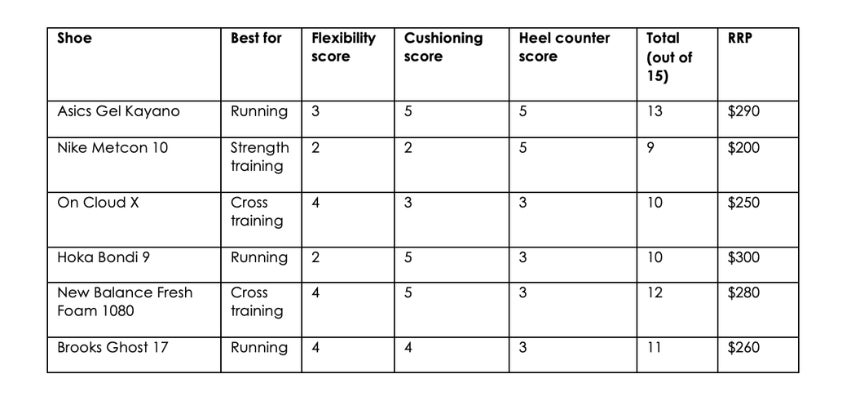
Ok, enough already about heel counters, flexibility and cushioning! Now it’s time to compare popular shoe options and score them against the three factors discussed above.
Note: Scores are ranked one to five, from least to most. For example, a cushioning score of five means the shoe has the most amount of cushioning.
The quick answer to the best training shoes for your purpose
- Asics Gel Kayano – a good running shoe, especially long distance.
- Nike Metcon 10 – the best gym shoe, especially if you’re mostly lifting and strength training.
- On Cloud X – a good cross training shoe for those looking to do a bit of everything, i.e. classes, treadmill and weights.
Join a run club in Melbourne or Sydney with Virgin Active
Now you’ve found the best training shoes, it’s time to tie those laces and get out there! And there’s no better place to get moving than at a Virgin Active run club. Find a run club near you below:
Run Club Melbourne (Collins St, CBD)
Run times:
- Wednesday 6:45am
- Thursday 6:45pm
- Saturday 9:20am
Run Clubs Sydney
Run time: Saturday 7:10am
Run time: Wednesday 5:45am
Please note that class time and availability may be subject to change.


Enjoying our blog?
Sign up to our newsletter to get updates on training, healthy living, news and events.